
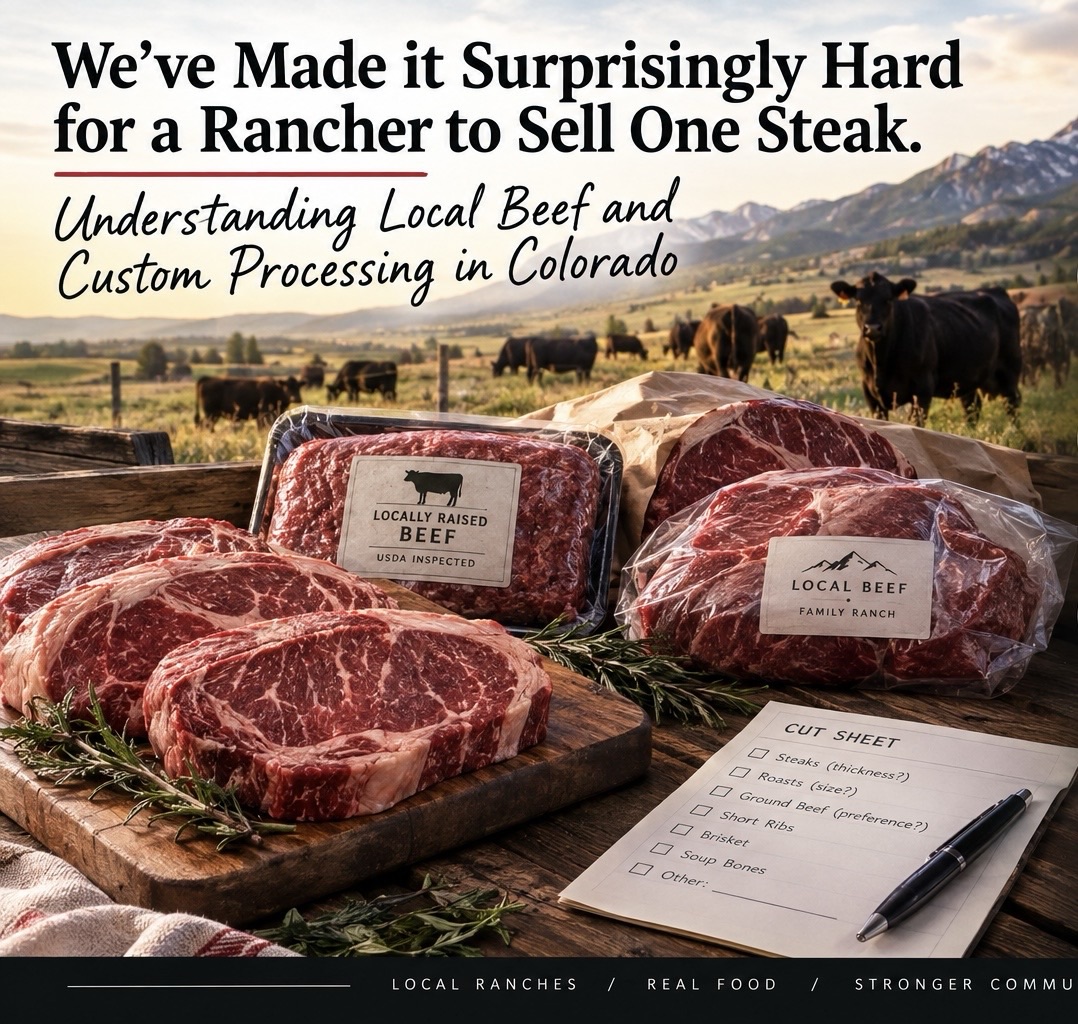
You drive past cattle grazing in a Colorado pasture. Maybe you know the rancher personally, met them at a farmers market, or discovered their operation through the Colorado Farm & Ranch Directory.
You think, Why can’t I just buy a few steaks directly from them?
Sometimes, you can.
Some Colorado ranchers have their cattle processed through USDA-inspected facilities and sell individually packaged beef directly to consumers. You may be able to buy a couple of ribeyes, a package of ground beef, a roast, or a freezer box—much like you would at a retail store, but directly from the people who raised the animal.

Other ranchers operate differently. Instead of maintaining an inventory of individual packages, they may sell beef by the whole, half, quarter, or another ownership arrangement and use custom-exempt processing.
Understanding the difference helps explain why one local ranch can sell you two steaks while another may ask you to purchase a portion of an animal.
Three Ways Local Beef Can Reach Your Freezer
1. Buying USDA-inspected, individually packaged beef
This is probably the easiest purchasing model for consumers to understand.
A rancher can have cattle slaughtered and processed under USDA inspection and, when all applicable requirements are met, sell the resulting packaged meat directly to customers.
That means you may be able to visit a ranch store, farmers market, website, or other authorized sales location and purchase exactly what you need:
- A package of steaks
- Ground beef
- A roast
- Short ribs
- Brisket
- Soup bones
- A variety box
You’re purchasing finished meat, not an ownership interest in a live animal.
For consumers who don’t have room for a quarter or half beef—or simply aren’t ready to make that large of a purchase—this can be an excellent way to support a local ranch.
But there’s considerably more happening behind the scenes than simply raising the animal.
The rancher has to coordinate inspected slaughter and processing, pay processing costs, manage packaged inventory and freezer storage, and find customers for the entire animal, not just the ribeyes and tenderloins everyone wants first.
When you purchase an individual package of locally raised, USDA-inspected beef, you’re supporting both the work that went into raising the animal and the additional work required to offer that beef as a retail product.
2. Buying an ownership interest in an animal before processing
Another model involves customers acquiring ownership of all or a portion of a live animal before slaughter, subject to applicable requirements.
That’s an important distinction.
Instead of walking up to a freezer and saying, “I’d like two steaks and five pounds of hamburger,” you are acquiring an ownership interest in livestock. The beef you ultimately receive comes from an animal in which you held that ownership interest.
Depending on the arrangement, an animal may have multiple owners. That’s one reason you’ll hear ranchers talk about purchasing a whole, half or quarter beef.
However, terminology alone doesn’t determine how a transaction works. Simply calling something a “quarter beef” doesn’t necessarily explain the underlying arrangement.
If you’re purchasing through an animal-ownership model, ask the producer to explain what you’re purchasing, when ownership transfers, who owns the animal at slaughter, and how processing is handled.
3. Custom processing for an animal’s owner
Federal law also recognizes custom-exempt slaughter and processing.
In simple terms, custom-exempt processing allows livestock to be slaughtered or processed for the animal’s owner without producing meat for ordinary retail sale.
Custom-processed meat is marked “Not for Sale.”
That’s the critical difference.
A rancher can’t simply have an animal custom processed, put all the packages into a freezer and then sell a ribeye to one customer, five pounds of hamburger to another, and a roast to someone else as retail inventory.
So when a rancher tells you they can’t sell you just one steak, it doesn’t necessarily mean small ranchers aren’t allowed to sell beef.
It may simply mean their particular processing and sales model isn’t set up for individual retail meat sales.
So, What Am I Actually Buying?
This is one of the best questions a consumer can ask.
If you’re purchasing USDA-inspected packaged beef, you’re buying the finished meat product.
If you’re participating in an animal-ownership arrangement connected with custom processing, you may instead be purchasing an interest in the animal before processing.
Those are very different transactions.
With bulk beef purchases, you’ll also commonly encounter a cut sheet. This tells the processor how you want your portion of the animal cut—steak thickness, roast sizes, ground beef preferences and other options.
And there’s another important concept new bulk-beef buyers should understand:
Live weight, hanging weight and packaged take-home weight are not the same thing.
Bone, fat, trimming, aging and your cutting instructions all affect how much packaged beef ultimately goes into your freezer.
That’s why comparing a rancher’s bulk-beef price directly with the grocery store’s price per pound for a trimmed steak can be misleading.
Ask the rancher what weight the price is based on and exactly what the quoted price includes.
Why Doesn’t Every Small Ranch Sell Individual Packages of USDA-Inspected Beef?
For some small producers, that’s exactly the business model they’ve chosen—and it’s important to recognize the work involved in making it possible.
A ranch may raise relatively few cattle while still choosing inspected processing so customers can purchase individual retail-ready packages.
But that model comes with additional responsibilities and expenses.
The producer may need to:
- Secure inspected processing dates
- Transport livestock to the processor
- Pay slaughter and processing expenses
- Coordinate packaging and labeling
- Maintain adequate freezer capacity
- Carry packaged inventory until it sells
- Forecast how much beef customers will purchase
- Market many different cuts
- Sell enough of the entire animal to make the numbers work
Selling individual cuts also creates an inventory challenge that isn’t always obvious to consumers.
A steer doesn’t produce unlimited ribeyes.
If customers primarily want premium steaks and hamburger, the producer still has to find buyers for roasts, briskets, short ribs, soup bones and other portions of the animal.
For another small ranch, selling whole or partial animals and utilizing custom processing may make more practical sense.
Neither approach inherently means the rancher raises “better” beef.
They’re simply different ways of getting locally raised beef from a Colorado pasture into your freezer.
How Consumers Can Make Buying Local Beef Easier
Buying directly from a ranch can be incredibly rewarding, but it helps to remember that a small ranch isn’t a supermarket with an endless supply of every cut.
A few things can make the experience easier for everyone:
- Ask how the ranch sells its beef. Do they offer individual USDA-inspected packages, freezer boxes, whole animals, halves, quarters, or another arrangement?
- Reserve bulk beef early. Processing dates and finished cattle won’t necessarily line up with the day your freezer becomes empty.
- Respond promptly when your rancher or processor needs information.
- Ask whether pricing is based on live weight, hanging weight, packaged weight, or another basis.
- Ask whether processing is included in the rancher’s price or whether you’ll pay the processor separately.
- Learn basic cut-sheet terminology before submitting your choices.
- Pick up your beef on time. Processors and ranchers have limited freezer space.
- Make sure you have enough freezer space before purchasing a large quantity.
- If you only need a few packages, look for a ranch that offers USDA-inspected individual cuts or beef boxes.
And don’t be embarrassed to ask questions.
Nobody is born knowing what hanging weight means, how much freezer space a quarter beef requires, or the difference between USDA-inspected and custom-exempt processing.
Questions to Ask Your Rancher
Before purchasing local beef, consider asking:
- Can I buy individual packages of beef from you?
- Is your packaged beef USDA inspected?
- Do you offer beef boxes or bundles?
- Do you sell whole, half or quarter beef?
- Am I purchasing meat or an ownership interest in an animal?
- If I’m purchasing an interest in an animal, when does ownership transfer?
- Who handles the slaughter and processing?
- Is the meat processed under inspection for retail sale or through custom-exempt processing?
- What weight is your price based on?
- Is processing included in the price?
- Will the ranch and processor bill me separately?
- When do I need to complete my cut sheet?
- Approximately when will my beef be ready?
- How much freezer space should I plan for?
There Isn’t Just One Way to Buy Local Beef
That’s ultimately the most important thing for Colorado consumers to understand.
Some ranchers really can sell you just a steak. They’ve built their operation around inspected processing and retail-ready packaged beef.
Other producers have built their businesses around whole, half, quarter, or other animal-ownership arrangements followed by custom processing.
Both can connect Colorado families directly with the people producing their food—they simply operate differently.
So the next time you see cattle grazing in a Colorado pasture and wonder, “Why can’t I just buy a steak from that rancher?” don’t assume the answer is no.
Ask.
You may discover that you can buy two steaks today. You may find a ranch offering a convenient freezer box. Or you may decide that buying a quarter beef and learning how to fill out your first cut sheet is exactly what your family has been looking for.
One of the biggest questions consumers have when buying directly from a rancher is whether it actually saves money.
What Does Local Beef Actually Cost? Comparing Your Options
The answer depends on how you buy your beef, how much you purchase, what cuts you prefer, and whether processing is included in the price.
Buying a single package of locally raised beef may cost more per pound than buying in bulk, but purchasing a quarter or half of a beef requires a much larger upfront investment and enough freezer space to store it.
Here’s how the different options compare.
1. Buying Individual Packages of USDA-Inspected Beef
When you purchase individual packages of beef from a ranch that sells USDA-inspected, retail-ready meat, you’re paying for convenience.
You can purchase a couple of steaks for dinner, a few pounds of ground beef for the week, or a selection of different cuts without committing to an entire animal.
The price per pound will depend on the ranch, how the cattle were raised, the cuts you’re purchasing, packaging expenses and the producer’s retail pricing.
Premium cuts, such as ribeye and tenderloin, will generally cost more per pound than ground beef, roasts and less popular cuts.
When this can be more affordable:
You only need a small amount of beef at a time.
You have limited freezer space.
You want specific cuts without paying for an entire animal.
You want to spread your grocery expenses across multiple purchases.
You don’t want the responsibility of managing a large quantity of meat.
When this can be more expensive:
Purchasing individual steaks and other popular cuts can cost more per pound than purchasing a larger share of an animal. You’re also paying for the additional processing, packaging, storage and inventory management that allow the rancher to sell finished products individually.
For a family that eats beef regularly, buying individual packages over several months may ultimately cost more than purchasing in bulk.
2. Buying a Whole, Half or Quarter of Beef
Bulk beef can reduce the average cost per pound, particularly for households that regularly cook a variety of cuts.
When you purchase a whole or partial animal, the price is usually calculated using live weight or hanging weight, and processing may be included or billed separately.
When bulk beef can be more affordable:
Your household eats beef several times a week.
You regularly use ground beef, roasts, steaks and other cuts.
You have enough freezer space to store a large quantity.
You can afford the larger upfront payment.
You want to reduce the average cost per pound over time.
When bulk beef can be more expensive:
You don’t eat much beef and some of it may go unused.
You only enjoy a few specific cuts.
You have to purchase an additional freezer.
You have limited cash available for a large upfront purchase.
You end up paying for processing, delivery or storage that wasn’t included in the original quote.
A quarter of beef may look like a substantial purchase, but it can provide many months of meals for a household that regularly eats beef. The important thing is to calculate the cost based on the amount of packaged meat you actually take home, rather than just the hanging weight.
3. Buying an Ownership Share and Using Custom Processing
When you purchase an ownership interest in an animal before processing, your costs may be divided between the purchase of the animal and the processor’s fees.
Depending on the arrangement, you may pay the rancher for your share of the animal and pay the processor separately for slaughter, cutting, wrapping and packaging.
When this can be more affordable:
You have access to an animal at a competitive purchase price.
You are comfortable buying in bulk.
You want to choose your own cuts and packaging.
You can make use of a variety of cuts rather than just premium steaks.
You have a good understanding of the additional processing costs.
When this can be more expensive:
The animal’s purchase price is high.
Processing fees and additional services add substantially to the total.
You pay for more beef than your household can reasonably use.
You aren’t prepared for the upfront costs or freezer requirements.
It’s important to understand that an ownership arrangement is not automatically cheaper than purchasing USDA-inspected packaged beef. The final cost depends on the animal’s price, its hanging weight, processing fees and the amount of usable packaged meat you receive.
Custom-exempt processing also has legal restrictions. Meat processed this way is for the animal’s owner and is marked “Not for Sale.” An ownership arrangement must reflect a genuine ownership interest and meet applicable requirements; it isn’t simply a way to purchase individual retail cuts through a different label.
The biggest difference isn’t always the price per pound. It’s how much you need to spend at one time, what you actually receive and how much of that beef your household will use.
How to Figure Out Which Option Saves You Money
Before comparing prices, make sure you’re comparing the same things.
A price based on hanging weight is not directly comparable to a grocery store price based on packaged meat. A portion of the hanging weight is lost during trimming, deboning and processing.
For example, if you pay $1,500 for a quarter beef and take home 150 pounds of packaged meat, your actual cost is $10 per pound of take-home beef.
That price includes the value of all the cuts you receive, not just the steaks. Ground beef, roasts, brisket, short ribs and other cuts all contribute to the overall value.
You can use this simple calculation:

You can then compare that number with what you typically spend at the grocery store or a local ranch store. Keep in mind that bulk beef includes a variety of cuts, so the comparison won’t be identical to buying only ground beef or only premium steaks.
Supporting Local Ranchers Doesn’t Have to Look the Same for Everyone
Buying local beef isn’t necessarily about finding the lowest price per pound. It’s also about understanding where your food comes from, how it was raised and what it takes to get it from a Colorado pasture to your dinner table.
For some households, purchasing two steaks from a local ranch every week is the most practical way to support a producer. For others, buying a quarter or half of beef makes more financial and practical sense.
And for ranchers, offering individual packages, beef boxes or bulk animal shares involves different costs, infrastructure and business decisions. Not every operation is equipped to offer every purchasing option.
The next time you find a local ranch through a farmers market, a neighbor or the Colorado Farm & Ranch Directory, ask how they sell their beef. Ask about pricing, processing, take-home weight and what is included. You may find an option that fits your family’s budget while helping support an independent Colorado agricultural operation.
When we understand the work and costs behind local beef, we’re better equipped to make informed purchasing decisions—and to help keep local agriculture economically possible for the people who raise our food.
Looking for locally raised beef in Colorado?
Explore the Colorado Farm & Ranch Directory, created by Discern Insurance, to discover independent farms, ranches and agricultural producers across the state.
Whether you’re looking for individual cuts, a freezer beef purchase or other locally produced goods, connecting directly with Colorado’s agricultural community is a great place to start.
Supporting local agriculture helps keep independent farms and ranches part of Colorado’s future.